
After the Bottleneck Disappears
How AI transforms presidential power when execution constraints disappear—plus press releases, content licensing wars, and deepfake satellite imagery

If you’ve been following the AI race long enough, you eventually stop watching for product releases and start thinking about the second order consequences of abundant intelligence.
I remember the first time I used GPT-3. I dropped in a few lines of ad copy and asked, “Give me 50 variations.” It did. Instantly. Every one of them usable and some better than mine.
That was the moment I stumbled into the question that’s driven my thinking ever since: What happens after the bottleneck disappears?

For decades, the constraint on influence wasn’t ideas or strategy—it was execution. You needed writers, designers, coordinators, approvers. Scale required headcount. Speed required coordination. Quality required expertise. The economics of persuasion were defined by the scarcity of skilled labor and the time it took to move.
AI erased that constraint.
You can now generate a thousand personalized messages faster than you once drafted one. You can test every variation, target every demographic, and flood every channel—all at near-zero marginal cost.
First, a few signals on the future of opinion shaping.
The Signals This Week
Three signals of the future of opinion shaping and what they mean for people inside the Beltway.
1. Press Releases Become Structured Data for AI’s Brain
Sarah Evans argues the wire service is actually critical to feeding the machines
The press release is taking on a new role in the AI age. While critics have spent years predicting its death, the format turns out to be perfectly suited for large language models that need structured, timestamped information about what companies and organizations are doing.
This represents a fundamental shift in how we think about press release audiences. You’re not only writing for human journalists anymore—you’re writing for AI systems that will cite your announcement when millions of people ask about your organization, product, or policy position.
Sarah Evans makes the case that press releases function as reliable data inputs for LLMs in ways that unstructured social posts and blog content can’t match. The format includes clear attribution, official quotes, contact information, and temporal markers that AI systems use to determine information freshness and authority.
Something to think about: The shift from SEO to what PR Newswire calls “Generative Engine Optimization” changes how you structure announcements. If your organization doesn’t have a comprehensive, machine-readable press release archive with proper metadata, you’re invisible to the AI systems that increasingly mediate how audiences learn about you. Build your press release pages with LLMs in mind—structured data beats narrative storytelling when machines are parsing for facts.
2. Universal Music Settles Udio Lawsuit, Bets on Reach Over Control
Major label makes first licensing deal with AI music generator, terminates user download rights
Universal Music Group settled its copyright suit with AI music generator Udio and announced a new platform launching in 2026. The deal ends UMG’s involvement in one of the industry’s highest-profile copyright cases, but the terms reveal something more interesting than legal resolution—a bet on a fundamentally different model for how creators monetize their work and brand.
Under the settlement, Udio’s existing users can no longer export or download songs they created (much to their chagrin). The new platform will exist as a “walled garden” where users can remix, mashup, and create music in the style of UMG artists who opt in, but everything stays inside the service. Creation becomes consumption.
For participating artists, the trade is explicit: give up control of your likeness and style in exchange for reach and a revenue share on both the training process and the outputs. Artists who opt in essentially become remixable raw material, compensated each time someone uses their voice or style.
Something to think about: This model will spread beyond music. We’ve already seen it with Sora’s Cameo feature where public figures allow anyone to create videos using their likeness. Some creators will trade autonomy for amplification. When Mark Cuban embeds “Brought to you by Cost Plus Drugs” in his Sora Cameo preferences, every user-generated video of him becomes his ad. That’s the future of reach: your digital presence becomes a distribution channel whether you create the content or someone else does.
3. Satellite Imagery Deepfakes Move Beyond Face Swaps Into Geopolitical Deception
Pentagon fire hoax tanked markets; India-Pakistan conflict saw dueling fake satellite images
Deepfakes of people saying things they didn’t say have dominated headlines, but fake satellite imagery represents a different class of threat. These are fabricated images of military bases, infrastructure, war zones and geographic features used to shape narratives about conflicts and crises.
TIME documented several 2024 incidents. Following Ukraine’s drone strikes on Russian bombers, fake satellite images circulated showing exaggerated damage. During the India-Pakistan conflict in May, both sides shared fabricated imagery suggesting they’d inflicted more destruction than occurred. Last year, a fake image of fire near the Pentagon briefly tanked the stock market before authorities confirmed it was a hoax.
The images work because satellite imagery has always carried an aura of objective truth. If you can see it from space, it must be real. But AI generation tools now produce satellite images indistinguishable from authentic captures, and most viewers lack the technical literacy to detect fakes.
The manipulation doesn’t require sophisticated military intelligence capabilities anymore. Researchers at the University of Washington demonstrated how generative adversarial networks can learn the visual patterns of one city’s satellite imagery and apply them to another location’s base map, creating realistic fakes that fool experts.
Something to think about: The same tools that enable hostile actors to fabricate satellite evidence work for legitimate communications operations that need rapid visual content for breaking situations. But the defensive imperative is what matters for Washington operators. Build verification protocols now, maintain crisis communication playbooks that assume any damaging satellite image might be fabricated, and develop rapid response capabilities that can counter false visual narratives within hours.
After the Bottleneck Disappears
Alan Z. Rozenshtein, an associate professor of law at University of Minnesota, just published “The Unitary Artificial Executive” in Lawfare. His thesis: Previous expansions of executive authority were constrained by human limitations. AI eliminates those constraints.
He identifies five mechanisms through which AI concentrates authority in the White House: emergency powers that never end, perfect enforcement that eliminates discretion, information dominance through message saturation, national security decisions too fast and opaque for oversight, and AI making the unitary executive technologically feasible for the first time. We’re going to cover three of these mechanisms relevant for everyone shaping public opinion.
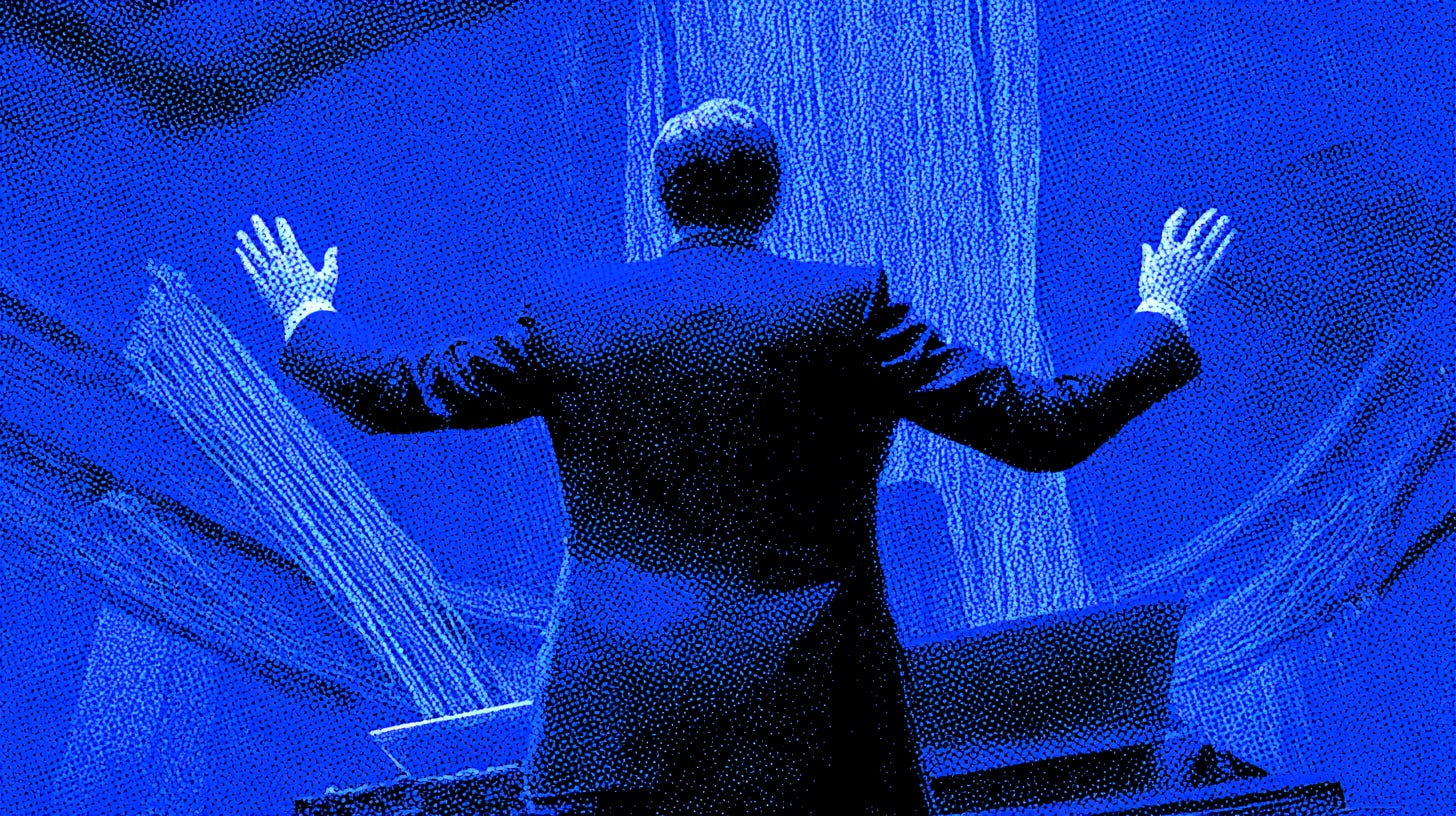
Flooding the Zone
AI enables message saturation at scales that were never possible before. The Supreme Court’s government speech doctrine says the First Amendment doesn’t restrict the government’s own speech. Until now, practical constraints limited scale. More messages required more people, more time, more resources.
AI eliminates these constraints entirely. Content generation at near-zero marginal cost allows engagement across all platforms simultaneously and personalized messages delivered to every citizen.
The approach operates in layers: personalized messaging that detects persuadable demographics and A/B tests in real time, platform algorithm manipulation to down-rank unfavorable coverage, and saturation through sheer volume that drowns out opposition through scale rather than censorship.
China demonstrates this works. Leaked documents from August revealed that GoLaxy, a Chinese AI company, built a “Smart Propaganda System” that monitors millions of posts daily and generates personalized counter-messaging in real time. The Chinese government used it to suppress Hong Kong protests and influence Taiwanese elections.
Traditional campaign operations measure every word carefully while others deploy thousands of variations, test everything, and adjust based on what performs. The velocity gap will soon creates structural disadvantage.
Perfect Enforcement
Pre-AI governance depended on enforcement discretion. We have thousands of criminal statutes and millions of regulations. Prosecutors choose cases. Agencies prioritize violations. Police exercise judgment. Discretion existed because resources were limited. There was never enough capacity to enforce everything.
AI eliminates that constraint. Facial recognition covers tens of millions of Americans while real-time camera networks monitor movement. Financial systems track transactions. Automated risk assessment scores individuals. When every violation can be detected and every rule enforced, discretion becomes a choice rather than necessity.
Rozenshtein’s example: Imagine DHS builds an AI system that identifies every visa overstay and automatically generates enforcement actions. No more “enforcement priorities.” The algorithm flags everyone, and ICE officers execute its directives with perfect consistency.
The same dynamic applies to influence operations. When AI can detect every policy violation, track every regulatory change, and monitor every stakeholder communication in real time, the information advantage goes to whoever processes that signal fastest. Perfect surveillance enables perfect targeting.
Realizing the Unitary Executive
The fifth mechanism enables control over how expanded powers get exercised. The unitary executive theory holds that the president must control all executive authority. The Supreme Court has increasingly embraced this view. But practically speaking, it’s always been impossible. One person can’t process information from millions of employees, supervise 400 agencies, and know what subordinates are doing across the vast federal bureaucracy.
It is increasingly looking like AI will remove that constraint.
In January, the Trump administration sent a “Fork in the Road” email to federal employees: return to office, accept downsizing, pledge loyalty, or take deferred resignation. DOGE deployed Meta’s Llama 2 AI model to review and classify responses. In a subsequent email, DOGE asked employees to describe weekly accomplishments and used AI to assess whether work was mission critical.
That’s just monitoring. Rozenshtein says the real transformation comes from training AI on presidential preferences. The training data is everywhere: campaign speeches, policy statements, social media, executive orders, signing statements. The result is an algorithmic representation of the president’s priorities. Deploy that model throughout the executive branch and every memo gets routed through AI for alignment checks, every agenda gets screened for presidential priorities, every recommendation gets evaluated against predicted preferences.
The president can now have an “opinion” on everything. EPA rule on wetlands permits? The AI cross-references it with energy policy. USDA guidance on organic labeling? Check against agricultural priorities.
This fulfills the Supreme Court’s vision of the unitary executive theory. Once the president achieves AI-enabled control over the executive branch, all the other mechanisms become far more powerful. Perfect enforcement becomes universal when presidential priorities are embedded algorithmically throughout government. Information dominance operates at massive scale when all executive branch communications coordinate through shared AI frameworks.
The Arms Race We’re In
Rozenshtein’s analysis is forward-looking but not speculative. Every mechanism he describes builds on existing presidential powers and fits within current constitutional doctrine. From a technology perspective, none of this requires artificial superintelligence or artificial general intelligence. All of these capabilities are doable with today’s tools.
It’s worthwhile thinking about how the removal of scarcity this transforms the broader private sector of influence work in Washington. BCG’s Henderson Institute recently published research on what they call “zero-employee competitors”—firms that operate with near-zero marginal cost per transaction, perfect memory and continuous learning across every interaction, and instantaneous adaptability when strategy needs to shift. When one customer service agent handles a difficult case, every other agent absorbs that learning immediately. Quality improves continuously while variance drops to zero. Strategy shifts weekly instead of annually.
A presidential campaign or advocacy group that adopts these approaches can generate thousands of message variants and test them simultaneously, identify every persuadable voter or stakeholder and deliver personalized content at scale, monitor every policy development and regulatory filing instantly, and respond to breaking news in minutes rather than hours.
The traditional model—careful messaging, multi-layer approval, human-driven coordination—can’t compete with that velocity. The 2026 midterms will be the first major American election where AI deploys at scale by all actors simultaneously—campaigners, organizers, citizens, and foreign operators—with no oversight and minimal understanding of second-order effects.
Rozenshtein’s analysis shows how removing execution bottlenecks concentrates power in the presidency. The same constraint removal is available to anyone shaping opinions.
When the bottleneck disappears, power doesn’t disperse. It concentrates in whoever moves fastest.
Best,
Ben